Twenty-Eight Degrees

There's an old saying in aviation: “It's better to be on the ground wishing you were flying than to be flying, wishing you were on the ground.”

There are dozens of aphorisms that get passed from instructor to student through the decades. If I had to pick just one to pass on to the students I hope to one day instruct, I think this would be it. It is a beautifully pure distillation of the philosophy behind aeronautical decision-making. It is also frighteningly true.

For about thirty seconds around Hour 288, my mind was flooded with a thousand competing thoughts. I was frightened---more frightened than I'd been in my life. I was flying blind, deaf, and mute. I had a critical decision to make and only seconds to make it. Quickly weighing my options, with survival seemingly in the balance, a quiet voice reminded me that, at that moment, I was flying while desperately wishing I was on the ground. It's a voice I hope never to hear again.

* * *

Hour 282

By the spring of 2005, I had settled into a great new job in Seattle. One of its many benefits was the travel: they'd pay for me to attend conferences all over the world once or twice a year. That spring I planned to attend conference in Los Angeles. Not exactly the most exotic locale, I'd be able to fly there myself!

South of Seattle and through most of Oregon, pilots enjoy the long, flat Willamette Valley, where the easy terrain makes for easy flying. California's Central Valley is similarly tame. Things get interesting in between. For over a hundred miles, the Siskiyou and Cascade mountain ranges dominate the border between California and Oregon. The craggy terrain juts impressively up past 14,000 feet at the peak of Mt. Shasta. I'd crossed this range on a couple of previous trips. The views were breathtaking.

Pilots of single-engine airplanes are usually leery of mountainous terrain because the options for emergency landings are limited. On the morning of my trip, I checked the weather and discovered I had much more serious concern. Multiple layers of clouds were pervasive along the entire coast, ruling out a flight by visual flight rules. The aviation weather service had also issued a warning for in-air icing above 6,000' along the entire west coast. The airways that traverse the Siskiyous were covered by this warning and require an altitude of 10 or 11,000' feet, well into the danger zone.

Ice is a grave threat to small airplanes. Once it accumulates on the wings, two bad things happen. The first is that ice adds weight. The extra baggage can keep the plane from climbing, and may even put it past its rated weight limit if the plane was heavily loaded from the start. Second, more insidiously, a layer of ice changes the shape of the wing, converting a surface that had been precisely engineered to generate the most lift into a random shape that doesn't work nearly as well. In some cases, the engine's air intake can also ice over, starving the cylinders of oxygen. The combination of these factors can be deadly: just as the pilot needs extra performance to escape the icing conditions, the plane both has less performance to give and more weight to carry.

That morning, clouds were layered all the way up to 20,000 feet, meaning a climb above the weather wasn't an option; my normally aspirated engine strains just to reach 12,000' on a warm day. I decided I had just two options. The first was to make the trip along the coast where I could stay lower, in warmer air. It meant doing a six-and-a-half hour trip in eight hours, but I wasn't in a hurry. The second option was to abandon the idea of flying myself and buy a ticket on a cushy commercial jet instead. 737s, after all, come with turbofan engines that can easily power the craft above the weather, anti-icing systems to protect the wings on the way up, and free peanuts.

I called the aviation weather service on the phone. When the weather is poor, I feel safer getting a human's opinion rather than just looking at a computer printout.

“Yeah, I definitely wouldn't try to go over the mountains,” the briefer told me. “But your coastal plan should work. Freezing levels are forecast to remain at 6,000' through Washington and Oregon.” Steering around the mountains along the coast, I'd be able to fly low enough to stay just under the freezing level.

Satisfied the trip would be safe, I filed a flight plan to my fuel stop in the coastal town of Fortuna, California. Most of the trip was uneventful, peacefully flying in between layers of stratus. The temperature stayed a couple of degrees above freezing. Reaching the California coast, a broken layer of clouds had formed beneath me. I descended into it on the instrument approach into Fortuna. While enveloped in the mist I looked out the side window and realized a thin layer of ice had formed on the leading edge of the wing. It was the first time I'd ever seen ice on the plane.

Before taking off, I'd re-read a brochure on in-flight icing. “If ice forms, take immediate action,” it had intoned. “If you wait too long, it may be too late! Ice can form quickly!”

My heart started to pound. But after a few moments of thought, I reasoned that the situation was probably well under control: I was already descending towards warmer air. The ice on the wing was minimal and not visibly growing. I could already see the ground below so I knew I'd be out of the clouds in less than a minute. There was more than 4,000 feet between the clouds and the ground. I decided to just continue in the descent. As expected, I quickly popped out the bottom of the clouds. The ice melted completely away before I even reached the ground.

That's how you do this, I thought to myself as I taxied to the fuel pumps. I was proud that I'd made a series of decisions stretching back to the morning that had gotten me this far safely. I couldn't help but smile.

I refueled the plane, stretched my legs, and grabbed some snacks from a vending machine. Then I dialed the aviation pre-flight briefing service to get an update on the weather before launching again. I did not hear what I expected.

“You're flying down the coast?” the briefer asked, with alarm in his voice. “There's strong westerly flow bringing very moist, unstable air in off the ocean. There's an AIRMET for icing above 6,000 feet extending inland about twenty miles. Areas of low ceilings throughout your route of flight; VFR not recommended.” He continued like this, making it sound like flying down the coast was certain death. “I'd head inland where it's warmer and dryer,” he said. “Flying down the Central Valley looks like a better option.”

Well, sure. If I were in the Central Valley, I'm sure flying down it would be just dandy. But I wasn't. I was on the coast, and some rugged peaks of the Siskiyous still stood in between.

“Look, uh...” I began, trying to keep from sounding frustrated. “I called a briefer this morning and he said going over the mountains was a terrible idea compared to going over the coast. But from what you're telling me, the coast is a bad idea. Have conditions changed since this morning, or...”

“Well, the mountains aren't a good bet, but the Valley is looking great. I don't know any Cardinals rated for flight in known icing, you know.”

Cute. “But I'm not in the Valley. I have to cross the mountains to get there.”

“True, but if you can find a way to reach it, the Valley should be safe. I think it's a safer option than the coast.”

“Okay,” I said, looking at my charts. “Well, let me file a flight plan on Victor 195 to Red Bluff.” That airway would take me over about 40 miles of high terrain, ending in the warm, wide-open Valley: Nirvana. I decided I'd try it, at least. If things looked bad once I got in the air, I could always turn back, try to stay low along the coast, or even spend the night in Fortuna to wait for better weather. I thought back to Steve, the flight instructor I'd met at Hour 236 in Holbrook, Arizona, who had coached me past the thunderstorms that had stranded me there. “You can always poke your head in there and turn back if you don't like it,” he'd said of the dark clouds. Would the same advice hold here, I wondered?
* * *

Hour 287

I launched into the cloudy skies, apprehensive. At about 6,000', I briefly climbed through the same layer of clouds I'd descended through before landing. This time no ice accumulated: a good sign. But the higher I climbed, the colder the air, and the larger the threat grew.

Normally, eastbound flights are at odd-numbered thousands---7,000', 9,000', 11,000', and so on. The altitude required to cross the mountains on that particular airway was 9,400', but I didn't want to climb all the way to 11,000. Lower air is warmer air.

“Oakland Center, Cardinal 97H...” I transmitted, talking to the controller for that region. “Can we stay at 9,400' on this segment?”

“Cardinal 97H, affirmative, maintain 9,400.”

I was in clear air, but clouds surrounded me above and below, left and right. I'd lost sight of the ground. Fifteen minutes later, as my chart told me I was crossing the higher terrain, I approached a cloud bank dead ahead at my altitude. It towered high above me---I probably wouldn't be on top of it, even if I had climbed to 11,000'. The bank extended as far as I could see to the left and right. Entering clouds seemed inevitable.

I checked the thermometer. Twenty-eight degrees.

“If there's ice, do a 180,” I said out loud to reinforce it in my brain. “You'll do a 180. If there's ice just turn around and go back. Just do a 180. Don't be a hero, just do a 180.” I hoped that saying it would make it easier to do it.

I penetrated the cloud and held my breath with one eye on the wing. It seemed clear, until thirty seconds later---

bang bang bang bang

A hard shower of hail hit the windscreen. The sound was deafening and terrifying.

The racket stopped after about ten seconds. There was now a thin layer of ice on the wing's leading edge which had been clear moments earlier. I can't believe this is actually happening, I thought. It was time to execute my plan to turn back, just as I'd said I would, just as I'd promised myself, just as my instructors would all insist I do.

I keyed the microphone: “Oakland Center, Cardinal 97H needs an immediate 180 degree turn!”

Pssssssssssssh.

The response was shrill static. Somewhere deep in the noise, barely perceptible, I heard what sounded like a human voice, far too quiet to understand. I began to panic.

It's the ice, I realized. Water attenuates certain radio frequencies. Maybe the plane's antenna had frozen over. Or maybe the ice in the cloud was dense enough to be blocking the signal. Either way, I couldn't hear the controller, and it seemed likely he couldn't hear me. A lump formed in my throat. I had never felt quite so alone.

For a few moments, I was stunned: the situation seemed unreal. After a few long seconds, I gathered my wits enough to start reviewing my options:

One was to just turn the plane around in the blind, without the controller's clearance. Nothing was visible out the window but the solid white interior of a cloud. I knew from my chart I could turn around without hitting terrain, but with no visual references and no radio contact with air traffic control, I couldn't be sure I wouldn't run into another plane. I tried to weigh the very real danger of ice with what I judged to be a tiny chance of hitting someone else: I was in a fairly remote patch of airspace and, in the past twenty minutes, hadn't heard any other aircraft on the frequency that were nearby. But there was no way to know for sure. Assuming ATC was still reading my transponder, I could set it to 7600---the special code that indicates I'd lost communication.

Another option was to grab my handheld radio from my flight bag and try to contact Oakland Center again. If problem was an iced-over antenna, my little radio might fare better. But it was tiny and only reliably transmitted a couple of dozen miles---fine for talking to a nearby control tower, but who knows how far Oakland Center's radio receiver was? And in fumbling around with this radio, I might just be wasting precious time. Every moment that slipped by was a moment I was penetrating deeper into the cloud. Should I turn back before things get worse?

I tried the aircraft's radio again: “Oakland Center, Cardinal 97H is turning back!” I shouted into my headset. Again I heard nothing but static.

bang bang bang bang – The hail started again, harder and louder than before, then stopped. The wing's leading edge was now coated with about a quarter-inch of ice. It had accumulated almost instantly. My heart was beating its way out of my chest, my ears heavy with the sound of pumping blood and my stomach a tight knot. I felt ill, in mortal terror.

Could I even turn back now? I knew there were at least two areas of heavy icing behind me, and turning around would guarantee that I'd go through both of them again. But what other option did I have? Ahead of me might be a dozen more areas of icing. Turning back would at least return me to the safety of lower terrain.

I longed to be on the ground. Why, I mused, had I even started flight lessons in the first place? Maybe Mom was right after all.

One thing was certain: I had to take action immediately. Self-flagellation and regret would have to wait. I started to turn the plane around when I saw the most improbable and beautiful sight I could imagine: a trace of blue sky directly above me.

A moment later I emerged from the cloud. My radio immediately crackled to life: “...Seven Hotel, did you say you want a 10 degree turn?”

“Standby!” I shouted. I was in clear air, but it wouldn't last. Another cloud bank was dead ahead; I'd reach it in less than a minute. I estimated it was only one or two thousand feet thick. Could I climb above it? It would be risky: with all the ice on the plane, the climb performance would be poor, plus I might be badly misjudging the height of the cloud. But would a climb be safer than turning back into the ice that I knew was surely behind me? I had to pick one immediately.

“97H would like a climb to one-one, eleven thousand,” I said.

“Cardinal 97H, climb approved,” came the immediate reply. I screwed the propeller's pitch knob all the way in and pulled gently on the yoke until the plane slowed to its best-climb speed. I watched, barely breathing, as the cloud got both larger and lower in the windscreen: which would win? The plane came though for me, just barely grazing the cloud bank as I climbed above it.

The victory was short-lived. A few minutes later, the lumpy cloud tops continued to rise with the terrain, forcing me yet higher, to 13,000'---the highest I'd ever flown. At this altitude, bottled oxygen is required after thirty minutes. I had none, and tried hyperventilating to keep my blood oxygen high.

I continued at 13,000', occasionally turning left or right to avoid the occasional cloud that was higher and stay in clear air. The worst seemed to be over. I was still highly stressed, but seeing sunlight and taking heavy breaths, my panic subsided. I flew on, checking the GPS incessantly, willing it forward, trying to stay focused as it counted down the distance left until the safety of the valley.

Twenty minutes passed. Each one felt like an hour.

At last, I reached the promised land; the mountains and solid undercast gave way to a thin broken layer of clouds with beautifully flat ground visible far, far below. I asked for and received a descent to 7,000'. My blood pressure began to return to normal as I flew down the valley. The temperature climbed to 35 degrees and over the next ninety minutes, the ice melted away slowly, almost reluctantly, until it was gone.

* * *

“When you start flying, you get two bags,” my instructor Gary told me once. “You get a bag full of luck, and an empty bag for experience. The trick is to fill your bag of experience before your bag of luck runs out.”

I certainly learned my lesson about ice. A backup plan is vital, and in a small airplane, a descent is usually the best backup plan. Tangling with ice when there's no way to descend is a really bad idea.

Encountering ice during a slow climb over flat terrain is usually pretty gentle: small traces appear slowly, giving the pilot time to react and descend again. But, as I later read, mountain ice is a different beast. The protruding terrain can abruptly force an air mass upward thousands of feet, causing moist air to be suddenly super-cooled, just waiting for a trigger---such as an airplane---on which to quickly turn to ice. This can be deadly.

By the end of the day, my bag of luck was lighter, but my bag of experience had grown, too. I just hoped it was growing fast enough.

Niner Seven Hotel

Hour 139

There's an old saying in aviation: if you're an aircraft owner, the two happiest days in your life are the day you buy your plane and the day you finally sell your plane.  Hour 139 started me on the road to one of them.

By the summer of 2003, flying had become my obsession. I'd gotten my private pilot's certificate at Hour 119, and with my Ph.D. thesis finally complete, I spent time on my new hobby every day: flying when I could, reading books from Stick and Rudder to Jeppesen's Instrument Commercial Manual, and chatting in online discussion forums. I forced myself to find other dinner topics with D., though. She enjoyed flying with me every now and then but was getting tired of hearing me talk about it. I can't say I blame her.

The restrictions of being a renter started to wear on me. I was still flying airplanes from my flight school's training fleet. They were doing good business. Planes were typically reserved for two-hour blocks randomly throughout every weekday and booked solid on weekends. To take a longer trip, the only way to get even six contiguous hours was to reserve it two months in advance. One sunny Saturday morning, I noticed a cancellation on the schedule and rushed to the airport with D. for a quick brunch in Santa Barbara. The scenery was fantastic, but she never quite relaxed knowing that we had to rush to get the plane back before one-thirty.

I started to put together a list of reasons why I should buy a plane. Imagine the sense of freedom being able to fly on a moment's notice without having to have the plane back in time! Or the excitement of taking an overnight trip to another state! Or how cool to be chatting randomly at a party and be able to say, "Why yes, I am a pilot! Let's get out of here and fly somewhere."

I even managed to convince myself that buying a plane might save money. Rental aircraft are billed per hour that the engine is running. An odometer-like device called a Hobbs Meter ticks off tenths of an hour when it senses engine oil pressure. The rate—say, $120 per Hobbs hour for a Cessna Skyhawk—covers fuel, maintenance, insurance, depreciation, and other costs. But the actual cost to the owner is more closely related to the number of hours the engine is running at high power during flight. Seeing the Hobbs meter tick while I was taxiing and doing pre-flight checks always annoyed me: Why am I paying for fuel I'm not even using? I'm just paying off someone else's aircraft loan instead of my own! I suppose we all lie to ourselves to rationalize our desires. There are good reasons to buy an airplane, but beware: saving money is not one of them.

So started my search for the perfect airplane. I was soon buried under an avalanche of options. Was it better to buy something common like a Cessna or a Piper, enjoying plentiful spare parts and experienced mechanics, or risk a more exotic model that might have better features? Did I care more about flying quickly, or comfortably? How many passengers did I want to carry? How far did I want to go? Should I buy an older plane fully certified by the FAA, or one of the newer, zippier models built from a kit and classified as "experimental"? I considered the risk of retractable landing gear, which improves speed and range, but adds weight and can require expensive maintenance—especially if I forgot to extend it before landing. An old aviation adage made that sound inevitable: "There are two types of retractable-gear pilots—those who've landed with the gear up, and those who will."

After weeks of poring over magazine articles and specification lists I was ready to stalk my prey: a Cessna Cardinal with retractable landing gear. I'd enjoyed flying Cessna's classic Skyhawk during my training. The Cardinal RG is similar enough to be familiar, but better in nearly every way: longer range, faster, roomier cabin, more passenger capacity, and prettier. It has big doors that make it easy to get in and out. Visibility is superb thanks to its large windows, lack of wing struts, and the position of its wing slightly aft of the pilot. It had a reputation of being stable and docile, making it easier to fly in clouds. There were only a few thousand of them: it had been manufactured for just eight years, from 1971 to 1978. I made it my job to find one.

I scoured the web looking for the perfect specimen. I borrowed a copy of Trade-A-Plane, a magazine with nothing but classified ads for aviation: aspirational pornography for pilots. I took notes on each one that I found, comparing the price to the equipment and age. Buying a plane is quite different than buying a car—every 1989 Honda Civic is more-or-less the same, but every plane is unique. Each has gone through decades of use and disuse and has its own history of repairs, upgrades, and in some cases, damage.

I called one seller after the next to ask for specifics. Soon, I'd written a script I would follow on the phone.  From reading buying guides and talking to other owners, I'd learned a litany of important questions to ask about an airplane and didn't want to forget any of them. I must have driven the sellers crazy: How fast does it cruise? Has it been in any accidents? Is it stored in a hangar, or outdoors? When was the last annual inspection? Have there been any gaps in the inspections? What's the condition of the interior? When was the glass last replaced? How does the paint look? Are there any squawks—that is, known defects? What are the cylinder compressions? How old is the vacuum pump? When was the propeller last overhauled? Did they also overhaul the prop governor? Are the radios clear? Are the complete logbooks available? Have all Airworthiness Directives been satisfied? Is it IFR certified? What's this plane's useful load? Are you the owner, or an agent? Why are you selling it?

This was how I ended up getting a ride with the most controversial salesman in the aviation business.

* * *

Anyone who has been in the market for a small airplane has seen his name. Anyone who owns an airplane, more likely than not, has received a postcard from him. Internet aviation forums are filled with posts debating him: friend or foe? Everyone seems to have an opinion about Barron Thomas.

Barron was, and probably still is, a broker selling used airplanes from his office at the airport in Scottsdale, Arizona. Owners who want to sell without dealing with buyers deliver planes to his ramp; he sells them for a fee. Searching online for Cardinals for sale, I came across several of his ads: nice-looking airplanes, fairly well-equipped, at low prices. What was the catch?

I did a web search for his name and found one debate after the next on whether or not it was safe to buy a plane from him.  "I don't trust that guy," someone commented. "He seems shady," said another. My first reaction was to run the other direction, until I noticed that their specific complaints about him were all pretty soft:

"He's extremely impatient with me on the phone."
"He won't tell me the tail number of the aircraft he's selling and he blurs the number out of the airplane photos. What's he hiding?"
"He said I have to come down and look at the logbooks if I want to know what's in them."
"I get these stupid postcards all the time asking if I'm ready to sell my plane yet."

He didn't necessarily sound friendly, but no one actually had any stories of being cheated. The tail numbers might just be blurred out to prevent buyers from contacting sellers directly, cutting Barron out of the deal. Perhaps I was just too trusting, but I was willing to give him the benefit of the doubt. I called him up. He seemed pleasant enough on the phone.

"Have all the Airworthiness Directives been complied with?" I asked at one point, following my script.
"I assume so, but you'd have to come down and look at the logbooks to be sure."

He had dozens of airplanes for sale. He did not know all the details of each aircraft from memory nor did he offer to research them. He made money by dealing in volume. If I was serious about the plane, he told me, I should come visit. The specifications and the price were posted online. Once there, I could spend as long as I liked inspecting the plane and its logbooks, and even go for a free test flight. The unspoken message, of course, was that if I wasn't serious, I shouldn't waste his time. Speaking to Barron was much different than speaking with owners directly: they'd chat my ear off about each upgrade and all the improvements they'd lavished on their babies. Barron was all business. I started to understand why some people didn't like him.

"Come look at the plane, and if you see anything you don't like ...," he said. The sentence made enough of an impression on me that I started to write it down in the notes I was taking while I was on the phone. My notes trail off. I don't remember how it ended.

* * *

I stared out the window, watching the caked orange dirt ubiquitous in Arizona go past. I was sitting in a shared-ride van I'd hired at the Phoenix airport. The driver was new and didn't know the area. Each of the other four people sharing the van, all locals, had convinced him that their homes were "on the way." I hadn't argued, even when it became clear we were driving in circles. As the rough terrain rolled by I lamented not being more assertive or a better negotiator, and wondered if I was heading towards a very expensive mistake.

"You're going to Scottsdale to look at a plane?" a pilot acquaintance at my home airport had asked when I mentioned I'd bought airline tickets. "So, Barron Thomas, then?" His tone was a strained politeness that would not have been out of place had I told him I was planning on doubling my retirement savings by investing in lottery tickets.

The van finally reached the Scottsdale airport. I climbed out and found Barron sitting in a large office he shared with his assistant, Lori. Barron was a stout man with short cropped hair who looked to be in his late forties, wearing a crisp white dress shirt and tie. Papers and file folders were stacked everywhere. Bookshelves lined the walls, largely filled with business literature: The Iacocca Management Technique.  The 7 Habits of Highly Effective People. A few years after I met him, I noticed several web sites described a similar book Barron had plans to co-author with Ben Stein: How You Can Sell Anyone Anything.

"Welcome, welcome!" he said, rising from his chair, smiling warmly, and shaking my hand firmly.  "Thanks for coming down. Aaron will show you the plane."

Aaron emerged from a back room. He was younger, tall, trim, and also smartly dressed in a shirt and tie. He removed the plane's keys from a small pouch and I followed him back outside, through the airport's perimeter fence, and to a large parking area where a couple of dozen planes were tied down in spaces labelled "BARRON THOMAS".

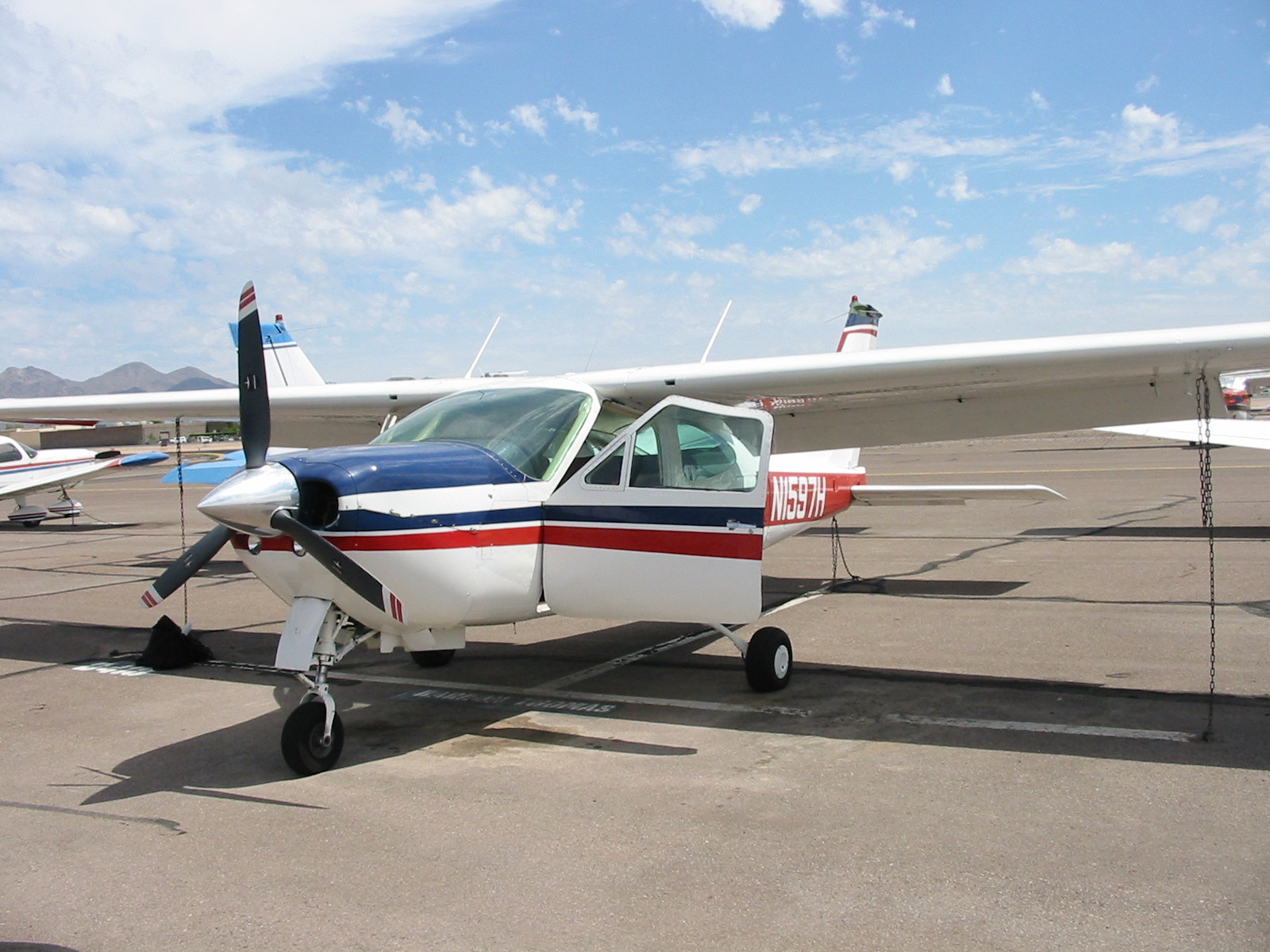
My first look at Niner Seven Hotel.
"Here she is," he said, leading me to a Cardinal that looked just like the photo I'd seen on their web site. He fumbled with the keys, trying to open the pilot-side door.  "Is this your first plane?"

"Yeah," I said, a little sheepishly.

"Oh, the Cardinal is a great first plane.  It's got ... uh ..." he trailed off, jiggling the key. "I can get us in."

He opened the small baggage door in the rear of the plane, shimmied through it, clambered over the back seat, and unlatched the door from the inside.

"Do I always have to open it that way?"

* * *

I met Tommy next. He was a flight instructor and the owner of the local pilot shop. Tommy was familiar with Cardinals and took me up for a test flight. He was an older fellow wearing a t-shirt, jeans and a baseball cap, reminding me of my own instructor. He seemed to be in a hurry. I suppose he could be forgiven for being curt since I wasn't paying for his time.

The flight was a blur. I'd never flown a Cardinal before, and had only a single flight in an airplane with a variable-pitch propeller or retractable gear. The plane had a bevey of gauges and knobs absent from the aircraft I'd flown during my training: cylinder head temperature, cowl flaps, fuel flow PSI, manifold pressure, propeller pitch. What did these even do?

I was sitting in the pilot's seat, but Tommy did all the work as we lifted into the warm evening air over Scottsdale.  "Okay, now retract. Remove the takeoff flaps. You'll want to lean it out to the top of the green after takeoff," he said mysteriously, moving the position of a knob. "Then bring the RPM down to 2,500, but keep the throttle at full. Watch your CHT, don't over-lean and keep the cowl flaps open if it's running hot." I was totally overwhelmed.

We barely had left the runway when we did a 180-degree turn and returned to the airport. At 0.4 hours, this remains the shortest flight in my logbook.

* * *

"So, what do you think so far?" Barron asked me as we returned to the office.

"It seemed fast. Really confusing," I said.

"That just takes practice. Please, have a seat," he told me, motioning to an empty desk and chair. "Let me get you the logbooks."

Barron busied himself in a filing cabinet and returned with a stack of binders and file-folders seven inches high, placing them on the desk in front of me. "Let me know if you need anything," he said. Then he returned to his desk and started making phone calls.

I started thumbing through the thick sheaf of papers, trying to make sense of it. I'm not a mechanic; most of it was foreign to me. What's a flap follower cable? Should I be worried that the door actuator turnbuckle needed adjustment? I longed to have an expert at my side: I barely knew how to fly, yet here I was trying to understand the maintenance history of a plane nearly 30 years old!

I sat back, exhausted. Barron was still on the phone. In fact, I noticed, he was on two phones: one resting on his shoulder, and the other in his hand as he dialed it.

"Yes, hello, this is Barron Thomas, calling for Joseph, please," he said into the phone he had just dialed. "Yes, I'll hold."

He placed that phone on his shoulder and put the other phone to his ear: "Hi Scott, this is Barron Thomas. I'm just calling to ask if you're still looking for that perfect Bonanza. I just got one in and I'd love to have you come down and take a look at it. All right. Thank you," he said.

He immediately dialed a new number: "Hello, this is Barron Thomas, calling for Dave. Yes, I'll hold."

Then on the other ear, the person he'd been waiting for had apparently come to the phone: "Hi Joseph, this is Barron Thomas..."

I had never seen anything like it. Even the time he spent on hold with a potential customer was being put to use trying to sell to someone else. Back and forth, from one phone to the other, the cycle continued as I watched in awe. What would happen, I wondered, if both people came to the phone at the same time?

I found out a few moments later: with one phone on each ear, and with a playful smirk crawling across his face, he said to both simultaneously: "Hello, this is Barron Thomas." Then, putting down one handset for a moment, he said into the other, "Please hold for just one moment."

As I closed the logbooks and packed up my notes it was five in the afternoon. Barron was ready to leave, too. He offered me a ride back to the Phoenix airport in his large, new sedan. He gave me some inspirational words during the trip: "Sometimes, you have to just take an opportunity. You can't sit trying to make a decision forever. If it feels right, you just have to go for it."

I'm not necessarily the most astute judge of character, I admit. But sitting in his office, watching his virtuoso performance on the telephone, I felt like I understood the source of Barron's reputation: chasing down leads as fast as his fingers could dial numbers, he clearly had little extra time to spend answering a long series of questions from random pilots who weren't really ready to buy. Brusque? Certainly. An ambitious salesman? Without question. But that didn't necessarily make him un-trustworthy.

At least, that's what I told myself up until the day, 8 years hence, that I read he'd been indicted for fraud, allegedly running a Ponzi scheme. The plane was a great buy, though.

Anything You Ask

Hour 19

“So, do you have a special lady friend?”

His question was a surprise. I hadn't had many personal conversations with my flight instructor. Gary was an older guy, crotchety, always wearing an old baseball cap over a thin ring of white hair, and occasionally prone to complaining about “women drivers” when he'd see an aircraft having trouble following the taxi line. We were sitting in the cockpit of one of the flight school's aircraft as I prepared to start the engine for the day's lesson.

I looked up from my checklist. “Uh, yeah,” I replied, a little cautiously.

“Oh,” he said, with a hint of disappointment. “Well, I've gone out on quite a few dates up there,” he said, motioning to the sky with his eyes. I had to hide a smile. If you met Gary on the street, your first thought might be that he enjoyed sitting in a rocking chair yelling at kids to get off his lawn. But Gary the Lothario? That was unexpected!

“Let me tell you something,” he continued. “If you take a woman up there on a first date, one of two things will happen. Either she'll run away screaming and never want to see you again,” he paused, looking at me.  “Or she'll do anything you ask.”

I laughed. I had no idea if he was serious. I went back to the checklist.


Hour 449

The next few years brought many changes: after graduating, I moved to Seattle, and my girlfriend D. and I eventually decided to part ways. When I started dating again, I remembered Gary's advice and -- okay, I'll admit it -- I was curious to see if it was true.

Soon after this, I found myself browsing an online dating web site, and tried using “flying” as a keyword. And there she was: well-read, fun-loving, in a professional career, ridiculously sexy, and with experience both flying and skydiving. What more could I ask?

“That one is not going to write back to you, dude,” my friend Dave told me when I sent her profile to him. “Write to her, but don't get your hopes up.”

“But I have an in!” I countered. “There's a picture of her with her arm draped over the propeller of a Cessna, and I recognize the airport from the pavement marking she's standing near. That's gotta count for something.”

“Eh, try it,” he said, doubtfully. “But she's ... well ... out of your league.”

My sister, a veteran of online dating, was also skeptical. “Bro, I love you, but a woman like that gets like a thousand messages a day. You have to set your expectations a little more realistically.”

“But her handle is I_Love_Nerdy_Men!  That's me!”

I wrote to her anyway: “Hey, that's Friday Harbor Airport, isn't it?  What do you fly?” A few days later, we were eating sushi and chatting like old friends. I suggested an aerial sightseeing tour for our second date and she eagerly agreed.

“Okay, here's what you do,” Dave said. “Make sure you have plenty of DVDs. When the date is ending, ask if she wants to come back to your place to watch a movie. It sounds better than just asking if she wants to come up to your place for a drink.” Dave is a dating ninja so I decided to give his strategy a try.

The following week we went out for dinner, then drove to the airport together. I pre-flighted the plane and got serious for a few minutes as I did the passenger briefing. We launched into the calm summer evening air and lazily circled over the downtown Seattle skyline without a care in the world. As the sun set over the Olympic mountains, the cockpit was filled with a warm orange glow, and L. was all smiles as she took the controls for a few minutes before I brought us back to Earth.

I was nervous as I put the plane away. Our date seemed to be going well, but I was afraid to ask her to come back to my place. I practiced silently in my head as I attached the tie-down ropes.

Just ask her if she wants to watch a movie or something.  Hey, want to watch a movie?  I have some movies. Want to watch one? Do you like movies? I have some movies. Just act natural. Act natural...

With the plane secured, I walked back to where she was waiting for me on the ramp, when--

“Hey, you wanna go back to your place and watch a movie?” she asked breezily as my mouth hung open, the same question sitting in it, half-formed. The fish had jumped right into the boat.

Oh, Gary. You old devil.

Spoiler alert: we got married almost exactly two years later!

Wedding rehearsal dinner, July 2008

Something's Not Right

Hour 996

It's not every day I find myself flying over Seattle with a dozen pairs of shoes in the back. It was a clear, quiet night, just after nine in the evening.  Night flying feels a little riskier any time I do it, but today was different.  We'd been in the air for just a few minutes when I had a sudden sense that something had just gone wrong with the plane. I couldn't tell you what, yet. The engine was still purring happily. But with 850 hours flying the same machine, I've gotten to know it, and somehow I knew that something wasn't right.

* * *

There's a fantastic military air museum in Tillamook, Oregon. They were producing a calendar filled with photos of ladies dressed as pin-up models posing against the museum's World War II-era aircraft. The curator had asked my wife L. to appear in the calendar so we were heading there for a photo shoot. She spent weeks excitedly putting together a dizzying array of outfits that I'd had the pleasure of previewing.

It had already been a long day. I'd driven between home and the airport three separate times trying to update the database on my brand-new GPS, fighting traffic each time. After work, we packed, but halfway to the airport, realized we'd forgotten something and turned back.  Though our original plan was to do the 75-minute hop in daylight, by the time finally reached the airport and packed all the suitcases and shoeboxes into the plane it was already after eight in the evening. Night was falling.

"I'm sorry -- I know we're already so late," I told her, "but I don't have my night currency."  It's pretty hard to maintain the legal requirement of three night landings in the past three months during Seattle summers; civil twilight is nearly 10pm at the solstice.  "I have to do three takeoffs and landings without you."

I started the plane up and did three respectable stop-and-go landings. I noticed something odd: during takeoff, with all my lights on, the ammeter showed the battery was discharging while the landing gear was retracting.  The alternator apparently wasn't generating enough power to keep up with the heavy electrical load. This probably should have been a clue that something wasn't right. Instead, I just tried working around the problem by turning off the taxi light during takeoff, and contemplated that it might finally be time to upgrade to low-power LED lights.

Returning to the ramp just before nine, I picked up L. and started the plane back up. We launched off of Renton into the clear night air and turned the plane south, contacting Seattle Approach to pick up our flight plan down to Oregon. The air traffic controller asked me to climb to 3,000'. I was busily trying to enter the list of waypoints the controller had given me into our GPS when it happened: I got a sudden sense that something on the panel had changed. I stopped, my finger hovering over my new touchscreen, wondering what was giving me the feeling that something wasn't right.

I started checking the panel systematically. All the primary flight instruments still seemed fine. The red post-lights illuminating the instruments were all still operating. The alternator warning light was not on. The wingtip strobes and navigation lights still seemed to be on, and I could see our headlight reflecting back off the propeller. The gear was up and the pump was off. Finally, I noticed it: my engine temperature monitor, which conveniently also monitors the avionics bus voltage, was flashing: "BAT 11.6V".

Wait, that must mean...

I checked the ammeter which measures whether the battery was either charging or delivering power.  The needle was pegged against the left-hand pin -- full discharge.  The whole plane was running off the battery. Uh oh. Airplane batteries are pretty small to save weight, so we didn't have a lot of time.

It was curious that the alternator's warning light was dark; it's why I hadn't noticed the problem sooner. I de-energized the alternator, which should cause the light to glow -- in fact, doing so had made it glow just ten minutes earlier when I'd tested it during the pre-flight engine tests.  I switched the alternator field on and off several times, but nothing changed.  I started to check the circuit breakers, when--

"Cardinal 97H, I can't climb you just yet, maintain 3,000."

Oops.  The failure had happened just after we'd reached 3,000', and I'd spent so much time heads-down trying to figure out what had happened that I'd neglected re-trimming the plane as we'd picked up speed. We'd climbed 300' above our assigned altitude.

"Sorry, descending to 3,000, 97H... and ... standby."

I was about to tell the controller what had happened, but decided I should tell my wife first.

"I'm really sorry, but, we have to go back," I told her. "The alternator isn't working."

"What does that mean?"

"The plane is not generating electrical power like it should. We have to land right away, because otherwise once the battery runs out, everything will go dark."

"You mean the engine will stop?" she asked, though to her credit, her tone was more inquisitive than concerned.

"Oh, no, no, the engine is fine, we're safe," I said.  I really have to work on my aviation problem-describing skills.  "It's just that in 10 or 20 minutes, the radios and lights will go out.  I have backups for everything, but we have to land as a precaution."  I started to mentally catalog my backup systems: my yoke-mounted GPS had 4 hours of battery; my flashlights were all out already; my handheld radio was behind me in my flight bag.

"Approach, Cardinal 97H," I said over the radio.  "We have to cancel IFR and return to Renton."

"Roger, IFR cancellation received, resume own navigation ... do you require assistance?"  Controllers are always so helpful if they think there's a problem.

"Negative, our alternator seems to have failed, but we should be able to get back on battery."

I turned the plane around and switched off all the lights to save power. A moment later, I realized how dumb that was -- there were other aircraft in the area, and I had just turned us into 2,500 pounds of invisible airborne aluminum. I flipped some of the lights back on. The legal requirement for anticollision lights isn't actually a bad idea!

I looked up, and, much to my surprise realized that I was lost. Perhaps it was just the stress of the situation, or my fatigue after a long day, but it was dark and I didn't recognize anything. The carpet of lights had no familiar features.  My new GPS suddenly seemed so confusing, despite the 15 hours I'd spent using the simulator before it was installed.  A few miles later I finally saw the flashing white lights at the end of the runway and brought us in for an uneventful landing.

After the plane was shut down, I called Seattle Approach on the phone. Before landing, when I'd asked to switch from their radio frequency over to Renton's, they'd asked me to call them from the ground. They wanted to make sure I was safe. When things go wrong, it's great to know that pilots nearly always have someone looking out for them.

I can't say this was my best day of flying, but honestly, the worst part was having to get in the car again.  At least there was no traffic!

Caution, Wake Turbulence

Hour 66

"What is that thing?" a disembodied voice asked through my headset.  It took a moment before I realized the voice was coming from inside the plane, not over the radio. Gary, as usual, was instructing me from the co-pilot's seat.  I'd forgotten that my friend Alberto was also sitting behind me.  He'd wanted to do some aerial sightseeing and had always loved airplanes so I'd invited him to ride along on one of my lessons.

"I don't know," I said. "But it's big."

We'd flown from Santa Monica to Long Beach where we were waiting to take off again.  An enormous plane was landing -- some sort of military transport, I guessed, so massive that it was hard to believe it was even capable of flight.  Yet there it was, coming down the last few feet and kissing the runway right in front of us.

We overheard the tower controller giving an instruction to a small airplane like ours that was still in the air: "Bonanza 65T, runway 30, clear to land. Caution, wake turbulence."

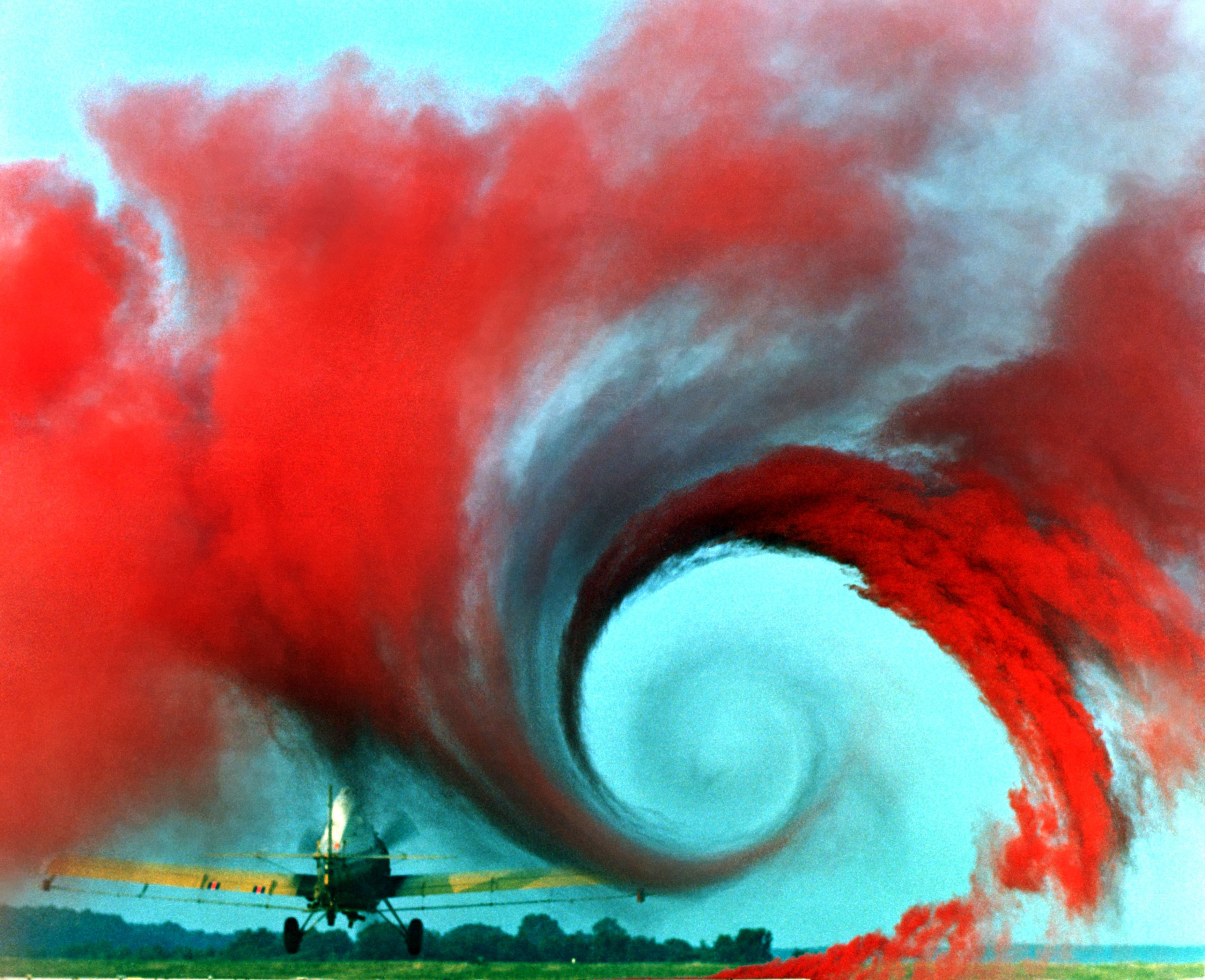
A wake vortex made visible in
a NASA test using colored smoke.
Wake turbulence is a disturbance in the air that is generated by any wing that's flying.  Wings go up by forcing air down.  The process generates swirling vortices at each wingtip that slowly fall to the ground, a little bit like the wake that spreads behind a speedboat planing through water.  Unlike a boat wake, wingtip vortices are usually as invisible as the air they're in. The heavier the plane, and the slower it's going, the more air must be sent hurtling towards the ground to keep the plane aloft -- and the larger these invisible menaces become.

A small plane caught in the wake of a much larger one can suffer serious consequences.  The plane may roll uncontrollably.  The FAA's Aeronautical Information Manual, in its typically understated style, warns that "in rare instances a wake encounter could cause inflight structural damage of catastrophic proportions." Pilots are trained to avoid this -- for example, by taking off before and landing later on the runway than a much larger plane that has just taken off or landed.  Controllers warn small-plane pilots of larger aircrafts' nearby wakes using the standard phrase, "Caution, wake turbulence."

"I was at an airport a few months ago and a Caravan was coming in," Gary recounted as we waited for our takeoff clearance. A Caravan is a plane several times bigger than our little Cessna 172, but still much smaller than a heavy transport plane like the one we'd just seen land.  "A big fella like that was landing before him.  The Caravan pilot decided to abort the landing, and the controller said on the radio 'Good idea.'  Wake turbulence can be scary stuff.  No one will think less of you for trying to avoid it."

It's one thing to hear stories about wake turbulence and read about it in books.  The real thing is quite another matter.


Hour 157

The dot-com boom lured many of my Southern California friends up north to Silicon Valley to try and make their fortunes.  Even after the tech bubble popped, most of them stayed. It was always fun to go visit them for a weekend of poker or a birthday party, and in my airplane it was a just two-and-a-half hour flight up through California's wine country.  One fine weekend afternoon I was on my way up for a visit.

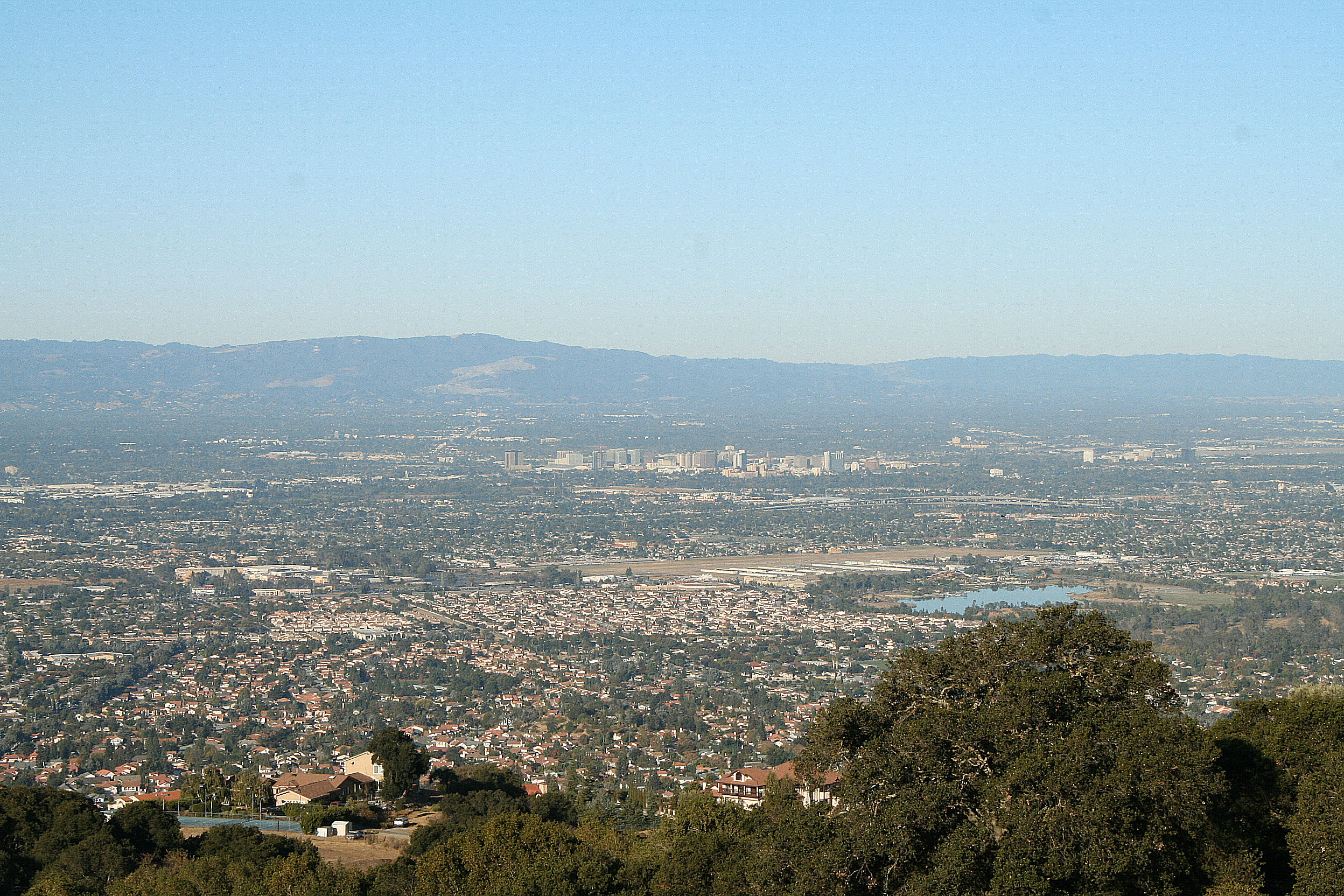
Silicon Valley
photo by Michael

True to its name, the Valley is a long, narrow basin just a few miles wide sandwiched in between two parallel mountain ranges.  Aircraft arriving from the south typically fly straight up it. On that day, I was no exception, flying at 4,500' as I made my way north-westbound on my way to the small Palo Alto airport.  The air was clear and calm -- one of those days that makes flying feel so easy and carefree.

I was talking to air traffic controllers at NorCal Approach. Even though it wasn't required, I always like to have an extra pair of eyes on me to warn me if I'm about to screw up.  The airspace is complex and there are big jets coming in and out of the San Jose and San Francisco airports... better safe than sorry!

"Cardinal 97H, traffic at your 6 o'clock will be passing 500 feet above you, a 737 restricted to 5,000," the controller told me.  "Caution, wake turbulence," she added perfunctorily.  I'd heard that warning so many times in the past year it had virtually lost its meaning.

Photo by Bill Abbot
I leaned forward and looked up to see an awesome sight: a big commercial jet painted with Southwest Airlines livery passing right over my head!  It was fantastic getting a close-up view of such a big machine in motion. They were flying the same track I was, right up the center of the valley on the approach into San Jose. I got a nice long look as he lazily pulled ahead of me.  I had a big, dumb grin on my face, thinking this is one of those cool sights that only pilots get to see.

My reverie was abruptly interrupted by the realization that the plane was in a 20 degree bank to the left.  I turned the yoke to the right to correct it.  Then something shocking and terrifying happened: absolutely nothing.

I've experienced almost every form of both elation and fear while flying airplanes over the last decade, but there's nothing more frightening than not having control of the airplane.  All the fancy-pants aeronautical decision making in the world isn't worth much if the airplane just won't do what you tell it to do!

I kept turning the yoke further and further to the right but the plane continued rolling left.  When I'd turned the yoke to its limit, the plane was still banked about 30 degrees.  We were in a standoff: the plane was not rolling any further left, nor was rolling back to the right.  It seemed quite indifferent to my control input, stubbornly flying with the right wing up as if it were stuck.

I realized I must be inside a huge, swirling wake vortex from the jet that had just passed overhead. Since the jet had been only 500 feet above me, the vortex hadn't had much time to disperse.  It was strong since the jet was about to land and was going slowly. And since he'd been flying parallel to me, I was flying straight down the long axis of the vortex like I was in a spinning tunnel. 

The controls abruptly returned to normal as my plane exited the vortex. Since the yoke was still turned all the way to the right, the plane rolled right quite enthusiastically, putting me wings-level in an instant.  I straightened the yoke and the plane kept on flying as if nothing had happened.

It felt like an eon, but the whole encounter lasted perhaps two or three seconds.  I'm lucky I was able to react so quickly.  If I'd been, say, trying to pee, the plane might have gone wings-vertical or even inverted.  Lesson learned: now, when I hear "Caution, wake turbulence," I keep my hands on the yoke!

Splashdown


This is the conclusion to the story of my first coast-to-coast trip, starting with Winslow and continuing in The Agony and the Ecstasy.

Hour 366

The third day of my coast-to-coast trip with Dad started blissfully: with plenty of sleep. In the high desert, the best strategy is to wake up before the sun rises and take off before the heat brings turbulence and higher density altitudes. Now safely east of all the high terrain, we slept in. The overcast kept our hotel room dark even after the sun came up. We returned to the Spirit of St. Louis airport at 9AM, refreshed and energized by the feeling that we were just a day away from our goal.

I checked the airport's weather computer. The overcast was just 500 feet above the ground and extended a hundred miles east. It would have been legal to take off, but I wasn’t convinced it was safe. If we needed to land in a hurry, or if my radio failed again, things might get a little "interesting." Even if we did take off, we wouldn't want to cross the nasty weather front that had been covering Indianapolis the night before. It had continued pushing east through the night and was now a couple hundred miles east of us.  The longer we waited, the further we’d be able to fly before reaching it. I decided the best course of action was to delay our departure.  We spent some quality time on the incredibly comfy couches in Thunder Air, the private-aircraft service station where we'd parked the plane the night before.

The confluence of the Missouri
and Mississippi rivers
By 11AM, the weather had improved considerably. The St. Louis area was nearly clear and airports along our route were reporting half-clear skies. The storm front had moved far enough east that we determined we could safely get all the way to Mansfield, Ohio. So, at about 11:30, away we launched into the scattered clouds. We were still west of St. Louis international, so air traffic controllers directed us north for about 10 miles until we were clear of their airspace. Then, we were cleared direct all the way to Mansfield. This clearance, itself, was a learning experience.

“Cardinal 97H, say on-course heading to Mansfield,” the controller said.

Heading to Mansfield? From here? That was two states away! We were barely out of St. Louis -- all I knew was the airway I was on.

“Heading is … uh … standby.” I fumbled with the GPS, trying to figure out how to get it to tell me the heading to a waypoint later in the flight plan. Finally I just took an educated guess: “About 070, I think?”

“Roger, Cardinal 97H, cleared direct Mansfield.”

Well that was new. In my time flying on the West Coast, I’d file a flight plan that followed airways, then fly on the airways, exactly as planned. In the middle of the country, where there’s less traffic and no terrain, I learned it’s common to get a direct clearance to points hundreds of miles away. I’ve since come to expect this. The best part about doing these cross-country trips is learning so many new things! I punched “direct-to Mansfield” into my GPS, wiping away the 9-leg flight plan I’d painstakingly entered before we took off.

The flight was relaxing, and mostly in clear air, but the threat of thunderstorms still hung in the air. The front we’d been behind for the past day was getting uglier, enveloping half the east coast.  As we made our way east we could see a long line of towering cumulus clouds way off to our right, reaching up to 45,000 feet and clearly visible from 100 miles away. They looked very imposing and I was happy not to be tangling with them.

In our descent we found ourselves in some patches of very bumpy cumulus for about 15 minutes. It was harder than our approach to St. Louis the night before.  The evening's stratus layer had enveloped us completely, reducing visibility to zero, but stratus is typically smooth and easy to fly in. Today, we were popping in and out of clouds and getting knocked around. I fought to keep us on course and wings-level, despite not being able to see the horizon visually. This is typical of cumulus clouds, and what often kills non-instrument-rated pilots. We got a couple of hard bumps that popped us into a 30-degree-bank, and my inner ear was, at one time, begging me to bank further over instead of leveling the wings. A big part of instrument flight training is learning how to ignore your inner ear and do what your artificial horizon says instead.

A few minutes before landing, another plane on the approach to the same airport reported going through an area of "heavy rain." A second pilot piped up, "We'd like to divert around that rain as well." A knot formed in my stomach. I longed for the same kind of weather radar they had, rather stuck inside the clouds, blind!

"Uh, Mansfield Approach, Cardinal 97H, could you clue us in what all those guys are diverting around?" I queried the controller, hopefully.

"They're all inbound from the east, 25 miles east of you," I was told. Relief washed over me as we descended through the clouds and landed. We were now within striking distance of our final destination!


Hour 369

We had a nice lunch in Mansfield and refueled. Then we checked the weather. The storm front we were avoiding had continued its journey east. It was still raining with low visibility in our destination of Ticonderoga. But we were in no rush. It was only mid-afternoon and we were a single, three-and-a-half hour flight away from our goal. We headed to the pilot lounge along with a gaggle of other pilots who were stuck there trying to get to various points on the East Coast.  I took a nap.

Two hours later we reassessed the situation. The front was curving off to the north-east, following the contour of the coast. The trip from Mansfield to Ticonderoga would take us far enough north that it seemed we could sneak in behind the front. Syracuse, NY was about halfway to Ticonderoga, and seemed like a safe alternative.  At worst, we could just land and spend the night in Syracuse, and complete the last hour of flying the next day. I decided to call the Flight Service Station and see what the professional aviation meteorologists had to say about it.

"I'm in Mansfield and am trying to get to Ticonderoga, or at least as far as Syracuse if I can. What do you think?"

"It should be possible," the briefer told me, "to get at least as far as Syracuse. But there's a second system coming in off Lake Erie, so you should stay south of Akron." He even gave me a series of waypoints to fly that would keep us out of the weather. Wow, now that's good service! "Just call us again over Elmira to see how the weather is developing," he suggested.

Dad and I launched again, with the briefer's suggested route programmed into the GPS. It was bumpy in the clouds so we climbed up to 9,000' to get above the tops. For about an hour, the flight was wonderful, as a strong tailwind from the cold front propelled us at about 172 knots (198mph). The clouds eventually enveloped us again, and as the sun gradually set, we lost visibility completely and continued solely on instruments.

Around Elmira, I tried to raise Flight Service on the radio to get an update on the weather. I tried a bunch of the local frequencies listed on the chart, but each seemed to be closed for the night.  Ten minutes of fruitless radio calls later I started to get anxious. Uh oh -- Strike One. (Well, let's call this Strike Two. Strike One was the fact that we had storm fronts around.) It was now too dark to see the storms. How close were they?

Then, Strike Three -- my primary cockpit lighting failed. My instruments are normally illuminated by tiny red lights mounted all over the panel. This system failed somewhere after St. Louis. Yikes. I have 6 flashlights in my flight bag, an overhead dome light, and a yoke-mounted light, so this wasn't an emergency. But it was another strike on the list of reasons to abort the flight.

Finally, Strike Four -- "Cardinal 97H, verify that you're still at 9,000 feet, I'm not reading your Mode C."

Oh, crap. Mode C is a feature that lets controllers see my plane's altitude. This is important for various reasons, but top on the list that evening was that the controller can warn me if I'm accidentally using an altitude that's too low. I reset the transponder several times with no effect.

As the strikes accumulated, I got more and more uncomfortable about continuing the flight. I started to look at the chart to decide where we could land. I wanted to be on the ground, no matter where we were!

I had just opened my mouth to say to Dad, "Let's just land and finish this tomorrow," when, like magic, the strikes started to unwind themselves one by one. First, "Cardinal 97H, contact New York Center now, and ask them about your Mode C -- the problem might be on our end." On your end? Why didn't you tell me that 10 minutes ago??

"New York Center, Cardinal 1597H with you level 9,000 direct Ticonderoga, can you verify you have our Mode C?"

"Uh, yeah, sure, I've got it loud and clear", this new controller said, in a tone as if I'd asked him if he knew the year was 2004.

The controller also helpfully provided us with a local frequency to get weather information, and we were able to contact Flight Service again. They confirmed that the path to Ticonderoga was clear! In fact, the second front was now moving in to Syracuse, so our desired destination of Ticonderoga looked like safer bet than our backup plan. He suggested a slight further deviation to the east to keep us out of the weather. My Mom, who was tracking our whole trip on the computer, later told us that we'd been depicted as driving exactly through the center of two parallel storm fronts. Score one for the Flight Service Station!

Using my yoke light and some new batteries, the cockpit lighting situation was also looking much better -- I had a fine view of the instruments.

And -- "New York, Cardinal 97H, I hate to sound paranoid, but can you please verify one more time that you see our Mode C?"

"Yep, I sure can," he said, sounding confident. And, just to top it all off, we were out of the clouds again! We could now clearly see lights on the ground. Hooray! This will work after all! My blood pressure returned to normal.

We flew on, breathlessly. Dad and I couldn't believe we were so close to our goal. In another 20 minutes we were close enough to hear the weather being broadcast from Glens Falls -- a good-sized municipal airport very close to our final destination. They were reporting clear skies!

By this time, we were talking to Albany Approach. After we checked in, the frequency was completely silent. It was 10PM on a Friday night; is this normal?

"Albany Approach, Cardinal 97H... radio check?"
"Cardinal 97H loud and clear."
"Great, we were just worried that we hadn't heard anything for a while."
"Yeah, it's just that time of the night."

Indeed it was.


Final Approach

20 minutes out from Ticonderoga, Albany Approach handed us off to Boston Center -- the agency that covers Lake George. The Boston controller asked us to "say approach request." She wanted to know: did we want a visual approach, or one by reference to instruments?

A visual approach would have been legal. We were in the clear; there was only a single layer of clouds high above us. But a visual approach would have been a bad idea -- I discovered that in the middle of upstate New York at night, when the moon is obscured by clouds, it is very, very dark. We could see an occasional light on the ground and nothing else. No horizon. No terrain. No ground features. No nothing!

"We'd like vectors to the GPS approach to runway 2," I replied.

Apparently I caught the controller somewhat unprepared. "Ticonderoga Airport" isn't really an airport as much as a lonely landing strip with some lights and a place to park. No buildings of any kind. The only service provided is a pay phone attached to a creaky wooden stake. Not a place that gets a lot of customers, as we discovered in a moment:

"Uh, Cardinal 97H, I'm not, uh, familiar with that approach..." she trailed off, with the sound of papers rustling in the background. "Where do you want to be vectored? I can get you as low as 4,200."

Ha!  Usually the controller knows the approach better than the pilot. Now she was asking me what she should do with us!

The instrument approach at Ticonderoga
"Can you take us to PULLO intersection?" I asked. I had the approach plate for Ticonderoga in front of me already, of course; PULLO was the name of the spot that starts the instrument approach.

"Roger, Cardinal 97H, proceed direct to... that intersection," she said.

And off to PULLO we went. We passed over Glens Falls airport. Perfectly clear and well lit, it would be an easy landing. The thought crossed my mind -- why not quit while we're ahead and just land here, right now? Well, we'll come back if there's any problem. Let's try Ticonderoga first.

Down, down into the inky blackness over AFRED intersection we descended, and further down near JADSU... just following the approach, like I was trained, trying to ignore the incredible excitement that was welling up inside of me, trying to ignore the fact that I was enveloped in total darkness making mountains invisible and with potential storms in the distance, trying to ignore the flash of light I'd seen that might have been lightning 100 miles away or maybe just a camera, trying to forget what it would feel like to land triumphantly, no, just trying to forget all that and focus on doing this damned approach correctly, getting the needle centered, trying to push everything out of my mind but that mantra -- fly the plane, fly the plane, fly the plane....

I looked up out the windshield at the black nothingness. It was like being locked in a closet. Totally featureless. Wait, except--- is that a green light I just saw? Airport beacons are white and green. Could it be?

I clicked my microphone-key 5 times. In theory, this should turn on the runway lights.

BAM! The most beautiful, perfect, gorgeous, lovely, fantastic runway in the history of aviation suddenly appeared in my windshield. It was a tiny line of bright white lights about 10 miles away.

"Oh my god, oh my god!" I started to shout. "I see the runway, there it is, there it is, there it is!"

My dad was beside himself. I had asked him a half-dozen times in the last ten minutes not to talk or distract me in any way, as this was a critical phase of flight and I was trying to stay focused. Now I was afraid that he was going to burst right out of his seatbelt with pent up excitement.

But, no, fly the plane, fly the plane, fly the plane.... in the long moments I'd spent looking out the window at the far-away runway, we'd drifted 30 degrees off course. Dammit, stop looking outside, this isn't over, just fly the plane, get that needle centered...

We proceeded on the approach, descending until we reached the minimum altitude for circling around. I wanted to land straight ahead, to the north, but my GPS was telling me that our groundspeed was 115 knots while my indicated airspeed was only 90 knots. Too fast, way too fast, clearly the wind was still at our backs! So, we went right past the runway, another mile north, then turned back to the south, still unable to see anything but the runway lights. I turned on all my landing lights, extended the flaps, and down we went again, aiming for that beautifully lit runway.

1,000' ... 900' ... GUMPS OK, before-landing checklist complete. 500' ... 400' ... Flaps 30. GPS groundspeed is down to 65 knots. Perfect. Check again that the gear is down. Green light is on. Runway lights set to maximum. 300' ... 200' ... everything seems right. I see no reason not to land.

50 feet. 30 feet. 10 feet. 5 feet.

Squeak.

It's hard to describe this moment. It's emotional even writing it down. It was sort of like the end of Apollo 13, when the ship finally splashes down in the ocean.

While we were still rolling out, I started to hyperventilate. I couldn't believe that we were actually on the ground in Ticonderoga. We'd come thousands of miles, met so many people, gotten a blown radio repaired, and battled storm fronts, high density altitudes, and the Rocky Mountains. This whole experience had seemed larger-than-life, and I had fantasized about landing at this airport for so long... it was almost incomprehensible that we were actually there.

I didn't use the brakes, but instead added a little power and let the plane roll to a gentle stop at the south end of the 4,000' runway, where the tiny tie-down area and my jubilant family awaited. They waved at us; I flashed my landing light back, pulled into a parking space, and shut the plane down. I opened the door. In an instant, while I was still wearing my seat belt, my Mom was at my side. We had a tearful reunion and she hugged me like I was the last life vest on a sinking ship.

We'd done it!

The Agony and the Ecstasy


I have to open this story with an admission: I didn’t tell the entire story of my flight out of Winslow. For every takeoff, there must be a landing, and the landing in Alburquerque would not have happened the way it did if the takeoff in Winslow had gone differently.


Hour 358

Even after the engine cooled after our frightening takeoff, the flight was not pleasant. The desert floor was heated by the unrelenting late August sun and made for one of the most turbulent flights I’d experienced. As a passenger, turbulence can be nauseating and frightening; as a pilot, it’s exhausting. During the cruise phase of a normal flight I get to sit back, relax, and enjoy watching the world pass underneath. In turbulent flight, it’s a constant battle to keep the plane on the right heading and at the correct altitude, constantly re-trimming and fussing with the throttle, rarely getting more than a few moments of rest. My stress level skyrocketed as we left Winslow, and the turbulence kept me from ever really relaxing even after the threat of mushing into the ground on takeoff had abated.

By the time we reached Alburquerque, I was ready to be on the ground. The problem was I was scared of the ground. I delayed our descent as long as possible, and made my final approach at nearly twice the recommended speed. I kept thinking, “If I have to abort the landing and go around, I want to make damned sure I have enough speed to climb out.” I’d been so frightened by what happened in Winslow that I was now irrationally hoarding energy exactly as a man who once almost died of starvation might hoard food. My approach speed kept creeping up and up -- the runway is 13,000’ long, I reasoned, so why not?

Touching down at 120mph in a plane whose normal touchdown speed is 65 certainly taught me a lesson. The moment the main landing gear touched the tarmac, the nosewheel came slamming down and the plane bounced 30 feet back in the air. I tried to coax it back down, overcorrected, landed nosewheel-first again, and bounced another 20 feet up. After a third bounce I realized what was happening and, near the top of the bounce, applied full power with the intention of going around. I then had a moment of terror: even at full power, I could not completely arrest the descent. The pilot-induced oscillation was so bad at that point that after the bounce the plane continued its trajectory slowly downward until the mains kissed the ground with the engine blazing. In an instant, I decided this was good enough, cut the power again, and focused on keeping the plane on the runway centerline as I bled off airspeed for the next 4,000 feet. I’ve flown that Cardinal for about 850 hours total now, and that landing in Albuquerque remains, by far, my worst.

Dad and I found a hotel. I had dinner with a depressed cloud over my head and fell asleep immediately afterwards, totally exhausted. During the night I had a vivid nightmare about crashing a plane into the side of a mountain and woke up the next morning with a deep sense of dread, regretting having taken the trip and wishing it were over.


Hour 359

The next day I resolved to solve the problems from the day before. Specifically:

  • We'd leave as early as possible, while the air was cool
  • We'd plan a short segment so that we'd be able to take off without full fuel, lightening the load.

Between the cooler air temperature (i.e., thicker air) and less fuel (i.e., lighter plane), the climb should be much easier. Of course, Dad was fine with waking up early, because he was still on East coast time and didn't want a repeat performance of Winslow any more than I did. We picked Dodge City, Kansas as our destination. My pilot friend Morten, who was also based at Santa Monica, had coincidentally been there the day before on his way back from OshKosh. He'd called to tell me it was a nice place to stop, and I also wanted to be able to say it was "time to get out of Dodge." Even the FAA has a sense of humor: the instrument approach has an EARPP intersection.

We were at the airport by 7am, where I put only 10 more gallons of fuel in the plane. By my computations, we'd still have fuel to make it to Dodge with 90 minutes or even 2 hours to spare.

I filed our IFR flight plan and by 7:40 we were holding in position at the end of ABQ's wonderfully long, 13,000 foot runway. I throttled up to full power and held the plane on the runway for as long as I possibly could -- we accelerated past the plane's normal rotation speed, called "Vr".  Then past Vr+5, Vr+10, Vr+15... by Vr+20 the plane was begging to be let into the air. I released the forward pressure I'd been holding on the yoke and we leapt up into the piercingly blue, crystal-clear sky. We climbed at 700 feet per minute! That's almost ten times faster than our climb out of Winslow. In fact, it's not unreasonable performance even for a sea level takeoff, home in Santa Monica!

My mood instantly changed. Ha, ha-- now I'm getting the hang of this!

Our trip over the remainder of the Rockies was wonderfully uneventful. The early morning air was completely smooth; we sailed over the mountains at 11,000 feet as if we were being carried along on a cloud. I was in fine spirits, happy about the trip again, and really enjoying looking down at the fantastic scenery. In two hours time, the Rockies gave way to Kansas and the Great Plains. Minute by minute we could see the terrain dropping lower and lower under us. Before we knew it, it was time to land in Dodge City, after penetrating a tiny layer of scattered clouds. I brought us in for a nice landing, which was quite a relief after my terrible performance in Albuquerque.

We taxied to the parking area, and I shut the plane down. But, oops, one more minor task--we had to cancel our IFR flight plan. In other words, we had tell Air Traffic Control that we were safely on the ground. If you don't do this, they send out a search and rescue party. I powered up the avionics, and on my #1 radio, started to announce, "Kansas City Center, Cardinal 1234H is on the ground in Dodge City, canceling IFR..." until there was a fizz and a pop and I realized my radio was completely dark.

Wait. What? No radio? Please tell me this isn't happening.

I turned everything off and back on again, hoping in vain that I'd flipped some switch the wrong way, but the sound of the "fizz.... pop" was all too distinct in my memory. The #1 radio was dead. My good radio! Arrrgggh!

Dodge City may be a great place to go if you want to see a re-enacted gun fight, or get cheap fuel, but it's not a particularly good place to find someone who knows how to fix a KX-155. Now what?

Well, first things first: after contacting ATC using my other radio, we had some lunch. The fine folks at the Dodge City airport lent us the crew car. We had a nice Mexican meal in town, and stopped by the local auto parts store to buy a fuse and some screwdrivers. Back at the airport, I took my radio out of the panel and confirmed that the fuse was blown... but, replacing it just resulted in another blown fuse. Something was wrong. And the nearest avionics shop was 120 miles away in Wichita!

But how do we get to Wichita with clouds in the sky and only one working radio? And a marginally crappy radio, at that? Its front panel looked more like a 1940s gas pump than like a piece of avionics.


Hour 362

After some soul searching, I decided to try the flight. My GPS was still working, which had been my primary source of navigation anyway. The #2 radio hadn't given me any problems. It was old, but sturdy. I had a backup handheld radio in my flight bag. And, although there were some clouds, they weren't that thick, and were a few thousand feet above the ground.

I was -- again! -- very nervous before the takeoff, but once we were in the air, I could tell the single-radio flight wouldn't be a problem. I was careful to write down all frequencies on a sheet of paper, instead of depending on my fancy but dead #1 radio to remember them for me. The clouds started to thin out, too.

Our trip to Wichita had an unexpected benefit: my homesick Cardinal got a chance to see its birthplace! The Cessna factory is near Wichita, KS, and we passed right over it on the way.

We were down through the clouds long before we reached the airport, so did a visual approach that didn't even require the radio's navigation functions.

After about 10 minutes of taxiing (Wichita is a big airport!) we arrived at the avionics shop that had been recommended by the folks in Dodge City. There, we found a kind gentleman who had about five lifetimes' worth of avionics experience piled on work-benches and bookshelves. At any moment it seemed his office would burst, covering everything within 100 yards with a strafing fire of half-assembled radios and stray transistors.

Luckily, this disaster was averted, and in 45 minutes our radio was repaired and back in the plane! We felt really energized and still had a couple of hours of daylight left, so we decided to press on with a third flight. Our first thought was to get to Indianapolis, IN, but a large weather front was between us and them, so we decided instead on St. Louis, MO.


Hour 363

We were in the air by 6pm. Since we were finally in areas of much lower terrain, we could cruise along at 7,000 feet instead of the 11,000 we'd been using for the earlier segments. At this lower altitude the engine has all the air it needs to develop full power. Plus, we had a nice tailwind, so the plane was scooting along at 165 knots (190 mph) most of the way. The sky was clear, our radio was working, our spirits were high -- we felt unstoppable!

By the time we got closer to St. Louis we were rapidly closing in on the cold front ahead and the bad weather that went with it. The further east we went, the more the weather was expected to deteriorate. Our intended destination of St. Louis International was reporting low visibility and light rain. 20 miles closer to us the smaller Spirit of St. Louis Airport sounded much more promising with a comfortable 2,000' between the clouds and the ground, and no rain. We advised ATC we'd be diverting to Spirit Airport.

Under control of ATC, we made our initial descent, and soon found ourselves sandwiched in between two solid layers of clouds. Then, in one magical moment, the setting sun came down below the upper layer, and joined us in between -- turning the clouds above and below into a stunning orange.

Finally, the sun set, leaving us in the dark. I activated my various cockpit lighting systems. And then on to the further excitement for the flight: an instrument approach that kept us in actual clouds for about 30 minutes. Many pilots do this routinely, but I learned to fly in Southern California, where an "instrument approach" usually means spending 2 minutes in the marine layer just before you get to the airport. Spending 30 minutes tooling around in the soup was a new experience for me!

We got vectored to the ILS. We had to take the "long way around," since the airport was landing to the west, and we were initially heading east. We had to go about 10 miles past the airport, do a slow turn back to the west and intercept the final approach course. Finally, the time came for our final descent on the electronic glideslope, and we broke out of the clouds at about 1,900'. By this time, it was dark, and a fine mist further reduced visibility, so we continued on the instrument approach. At about a 2 mile final (i.e., 2 miles from landing), we saw the beautiful line of sequenced strobe lights leading us right into the runway. And to top it off, I made a gorgeous landing.

As we shut down the plane and waited for a taxi, I reflected on the fact that days like this were really what made flying magical. There are certain sights and experiences that seem to be reserved for pilots only. I feel lucky every time I get to see one. During the minute and a half when the sun was with us in between two solid cloud layers, Dad and I were, most likely, the only two people on Earth who could to see it. Where on the scale of human experience do you put having your own personal sunset? I can only describe it crudely and say it was fucking awesome. If you’re a student pilot stuck in your training, or you’re still on the fence as to whether or not you should start, I have three words for you: get up here. You won’t regret it.